

Sometimes, on less humid days when the smog didn’t hang too thick above the lower bay, the view from the boardwalk was downright effulgent. I was a teenager at the time and so, by definition, not a morning person. Still, I would pause for a moment to take in the ocean view before entering the office and signing in for my 7 a.m. to 3 p.m. shift at the beach. On those exceptional early mornings, the newly risen sun lent the sky a soft rufescent glow and glinted off the steel skeleton of the Coney Island parachute jump far across the water. If there was a breeze, it carried the salty pungent aroma of New York City’s mid-1970s effluence, and the only sounds I heard were the caw of seabirds and the gentle lapping of the surf – unless, of course, a ruction of some sort broke out among my coworkers on their way to our locker room in the men’s bathhouse.
Most of them, like me, were high schoolers who had summer jobs because our fathers worked for the Department of Parks. Our official title was Seasonal Park Helper, or SPH. The lifeguards, our cooler and more lissome nemeses, hagrode us by saying SPH actually stood for Shit Picker’s Helper, but most people called us (and we called ourselves) Parkies. Our job site for the season was South Beach; that is, the municipally owned and operated South Beach on the east shore of Staten Island, in the virtual shadow of the Verrazzano-Narrows Bridge, not its Miami simulacrum in name only. Our duties mainly entailed using rakes and garbage stabbers to clear the mile-long strand of whatever zymogenic refuse had washed ashore overnight. Along the way, we also emptied an array of painted oil drums overflowing with the detritus of the preceding day’s blissfully sweaty sun worshippers.
All this noxious bounty – from the shit-laden Pampers to the dead rats to the used condoms we called Coney Island whitefish – we heaved into the back of an orange dump truck emblazoned with the parks department logo: a hybrid leaf, silhouetted and encircled. Most days, we finished the beach-scouring operation well before lunchtime. As for the rest of the day, our bosses usually exercised their limited suzerainty by telling us green-uniformed, minimum-wage nepo babies to get lost and avoid the tax-paying public until it was time to sign out at 3 o’clock. If anything, though, the tedium of those long afternoon hours hiding out under the far end of the boardwalk was harder to bear than the morning’s dirty work.
The only Parkies at South Beach who were spared that talion were the guys in the dump truck crew. After the cleanup, they enjoyed the privilege of driving the truck to the Fresh Kills landfill – a.k.a., the dump – to offload the day’s brominate mass of organic and inorganic waste. The crew included the driver and two fellow Parkies who accompanied him, center-seat and shotgun in the cab, ostensibly to help out but really, it seemed to me, just along for the ride. I coveted one of those seats. Anything for a change of venue. But our decemvirate of supervisors in the park office assigned them to more favored kids whose fathers, I suspected, had higher ranks or better connections than mine. And so I resigned myself to the ignominy of endless idle afternoons – until one morning when for some numinous reason I got the call. “Ledwith,” the foreman said, “you’re on the truck today.”
I didn’t question this directive but simply assumed there had been some mistake. And yet, when we finished our raking and stabbing two hours later, I found myself sliding into the cab of the big orange Ford as it pulled off the beach. We rode past the boardwalk, through the parking lot and onto Seaside Boulevard, the first leg on the trip to Fresh Kills. For the next half hour or so, I basked in the cool breeze blowing through the truck’s open windows and watched as first the tall reed grass and then the houses and storefronts passed by. Finally, on Richmond Avenue, I saw the man-made hills of the dump looming up ahead. We turned right into a clove carved out between the hills and there, for the first time, I caught sight of the landfill’s vast interior.
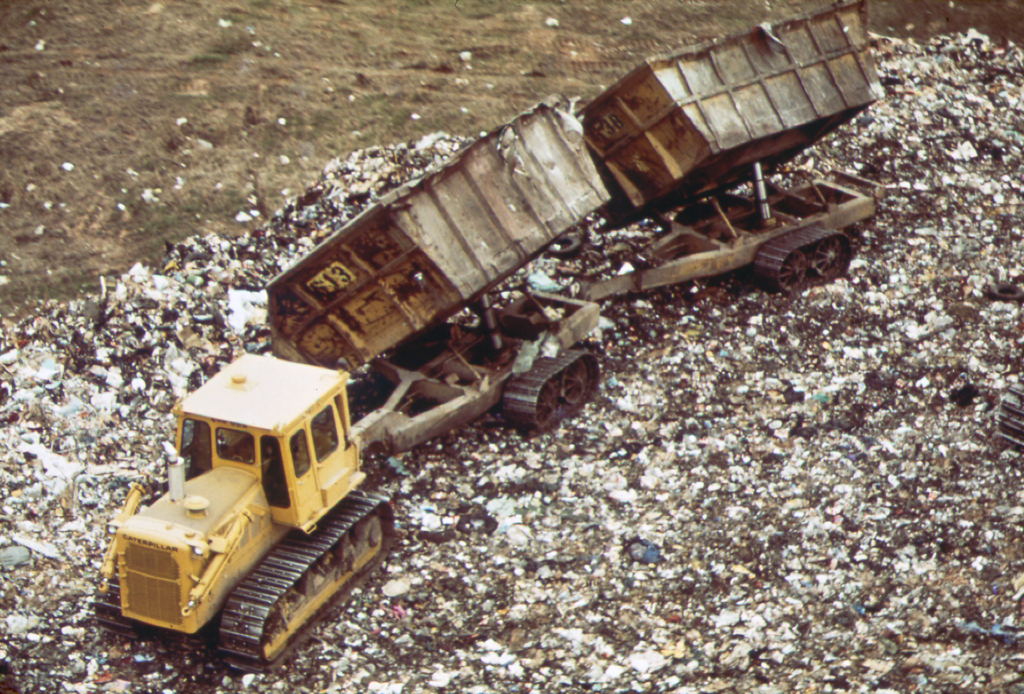
By the mid-1970s, Fresh Kills had already claimed the title of world’s largest garbage dump for twenty years (“visible from space!” people said), and it would keep growing for another quarter century until its closure, finally, in 2001. During all that time, to the dismay of native Staten Islanders, it was the sole defining feature of the borough that registered in the consciousness of most other New Yorkers. Nevertheless, what I saw that day was magnificent: a hellscape, to be sure, but on a scale that boggled the senses. Scores of tractors and bulldozers were in constant motion in the distance, pushing enormous quantities of refuse into compact mounds like an army of ants tidying up for the queen. Sanitation trucks lined up in front of us for a quarter mile or more, each awaiting the chance to drop its load. Above and upon the huge heaps of waste around us, so densely packed in some spots that you couldn’t see the garbage, were thousands of seagulls gorging themselves on urban excreta. The screeching of the gulls and the droning roar of machinery melded into a perfect soundtrack for the apocalyptic scene.
But as we drew closer to our drop-off point, it was the smell of the place that overpowered me more than all its sights and sounds. Fearing at first for my salubrity, I covered my nose and mouth with a bandana to block the strangely sweet fumes redolent of methane, burning plastic, rancid meat, rotting vehemence and death itself. By the time our load of South Beach coprolite slid noisily off the back of the truck, however, I had dropped the bandana and abandoned myself to the splendid stench. After all, I was out in the world now, not trapped indefinitely in a dank, sandy hideout. I had decided that I liked the dump. I hoped one day to return, although I never did. It smelled like freedom.

 Cross the Narrows