

When the City of New York and the union representing workers on the Staten Island Ferry finally reached a long-term labor agreement in September, I felt intensely – even unreasonably – proud. The pact provided about 150 crew members with their first wage hikes in thirteen years, an astounding period for any workforce to keep operating without a contract. It also awarded substantial retroactive payouts to the ferry workers, from deckhands to captains. But why did I care so much about this settlement, aside from my overall pro-union mindset? After all, I have no direct connection with members of the Marine Engineers Beneficial Association and am no longer a regular ferry commuter, though I was one for close to twenty years. The answer is that my connection with the story is, instead, ancestral. In the wake of the ferry workers’ triumph, I’ve taken a long-overdue moment to tease out at a strand of distant family memory and revisit the history of the big orange boats in New York Harbor.
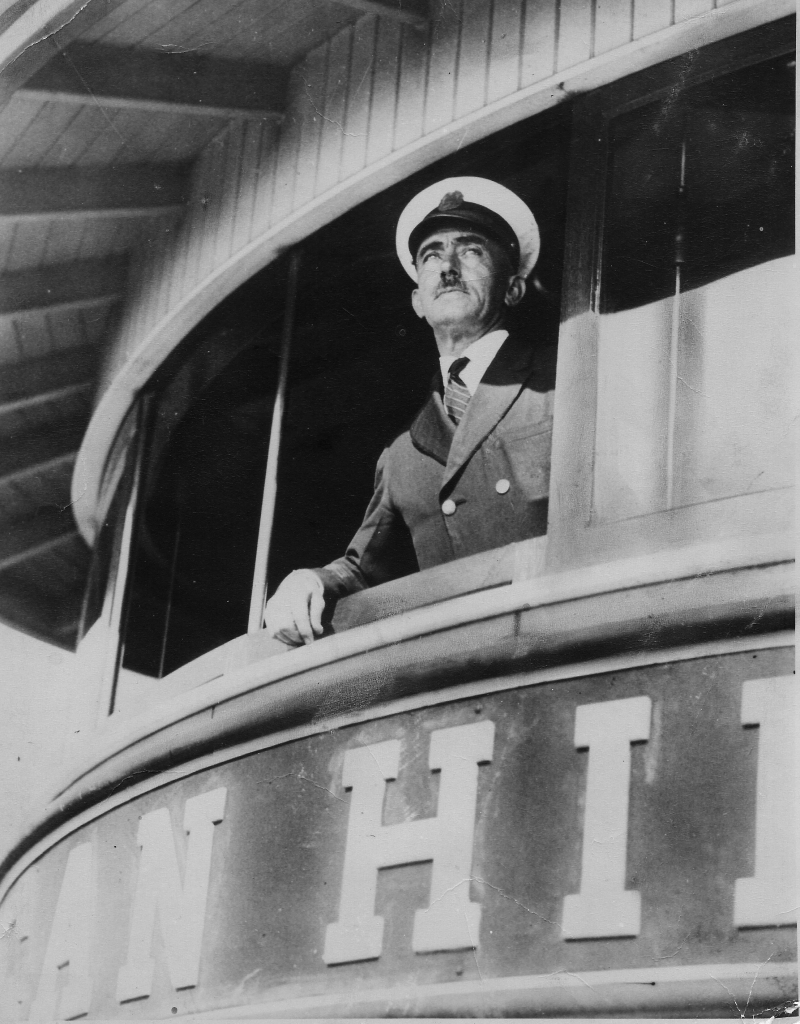
Many years ago, my introduction to that history was a vintage issue of The New Yorker with a long-form “Reporter at Large” story in which the reporter, Richard Harris, traveled to New York’s outermost borough to interview two veteran Staten Island Ferry captains, among other old salts. Published in September 1958, the piece amounted to a capsule oral history of the cross-harbor ferryboat service from the end of the 19th century to the middle of the 20th. One of the interview subjects, Captain Peter Merli, was still working at age seventy-four and had been plying the waters of New York City for more than fifty years. The other captain, John Hammel, my maternal grandfather, had worked on the ferries for forty years starting in 1892. By 1958, he was a long-retired widower in his late eighties.
Captain Hammel died two years later, when I was still a preschooler. I first came across his interview in The New Yorker as a teenager rummaging through a drawer full of family photos and mementos. I have held onto it ever since. Until recently, though, I thought of it as more emotional talisman than documentary resource. Reading my grandfather’s words on those yellowing pages brought him to life. This was a gift, because while he loomed large as a benign, distinguished patriarch in family lore, my few early memories of him were vague and unreliable. What didn’t catch my interest as much back then was the wider context of Captain Hammel’s involvement in a venerable and once vital New York transportation sector.
That historical context arrived in copious detail this year, when I finally read Brian J. Cudahy’s Over & Back: The History of Ferryboats in New York Harbor. Published by Fordham University Press in 1990, the large-format book contains 337 pages of annotated text and meticulously captioned photographs, supplemented by 117 pages of tables and appendices. It traces the history of every ferry line (and in the appendices, every individual boat) that ever carried passengers “over and back” from various points around the city’s harbor and rivers. I remember giving the book to my late mother, the youngest of Captain Hammel’s seven children, as a birthday gift at least thirty years ago. I am not sure she ever read it, and neither did I, until now.
The arc of Over & Back begins in 1812 with the first steam-powered ferry between Cortlandt Street in lower Manhattan and Paulus Hook in present-day Jersey City. It concludes with details about the four Staten Island Ferry boats that had entered service in the 1980s, a few years before Cudahy’s book was published. In his closing chapter, the author also predicts – correctly, it turns out – that the New York area was on the verge of a new era of ferry transportation. The new era began with two privately owned commuter lines that reestablished cross-Hudson service from New Jersey in the late ’80s and later branched out. It continued with the launch of NYC Ferry lines linking all five boroughs in recent years.
But back to Cudahy: For the most part, he relates ferry history with breezily informative prose. At times, however, he runs aground on the shoals of technical detail such as, for example, the thorny problem of “hydrodynamic inefficiency” in the design of early screw propellers in the 1880s. As these detours and the book’s appendices suggest, the author is a completist on his subject. A professor of philosophy by training, Cudahy nevertheless has bona fides in this field, having worked at the U.S. Department of Transportation and other transit agencies in past years.
He is certainly a stickler for classification. According to Cudahy’s criteria, a ferryboat is strictly a “double-ender” making regularly scheduled runs back and forth from point A to point B, discharging and boarding passengers from either end without ever having to turn about. Propulsion systems change over the years, from steam-powered paddle wheels to high-tech propellers turned by diesel-electric engines. Hull construction progresses from wood to iron to steel. Ferry management evolves over time, as well. It begins in the early 19th century with private operators dedicated to ferry service alone. Later in the century (but before the first bridges and tunnels cross the Hudson and East Rivers), the Pennsylvania Railroad and other train lines launch ferry lines to carry passengers to Manhattan from their terminals in New Jersey and Long Island. Later still, many routes shift to municipal ownership, which takes effect in earnest in 1905, seven years after the consolidation of Greater New York.
But through it all, by Cudahy’s lights, the basic ferryboat profile does not vary. In virtually every case, that profile includes twin pilothouses on the boat’s top deck, one for heading “over” and the other for coming “back.”
I know from the 1958 article in The New Yorker that John Hammel started his career on the ferryboat Southfield, and that he worked as a deckhand and then a quartermaster for the next fifteen years. After that, he spent twenty-five years as a captain in the pilothouses of various boats. I also know – though the magazine story doesn’t mention it – that he finished off his service at the helm of the Dongan Hills, part of what was by then the municipally owned and operated fleet of Staten Island Ferry boats.
Those bare facts, along with a smattering of family stories, comprised the sum of my pre-existing knowledge about Captain Hammel’s decades on the water. Upon this keel of rudimentary knowledge, Over & Back builds a superstructure of impressive detail.
For example, the Southfield, my grandfather’s first boat, was a wooden-hulled, steam-powered sidewheeler built in 1882 at a shipyard in Clifton, on Staten Island’s north shore. But it was actually the second Staten Island Ferry boat by that name. The first Southfield had been built in Brooklyn in 1857 and was sold to the U.S. Government for Civil War service in 1861. That boat sank in combat in March 1864, one of five New York City ferryboats lost among the twenty pressed into military service during the war. My grandfather’s boat, the second Southfield, was sold to the City of New York when the city government took over the Staten Island Ferry and several other ferry lines in 1905. It was peacefully retired from the fleet around 1912.
The Dongan Hills, the last boat captained by John Hammel, was a far more advanced vessel reflecting four decades of maritime technological progress. It was built at Port Richmond, Staten Island, in 1929, just three years before my grandfather’s retirement – so he was presumably its inaugural captain. Significantly larger than the Southfield, the Dongan Hills was steel-hulled and diesel-powered, with screw propellers in place of antiquated paddlewheels. The vessel would remain in rotation on the ferry line until the 1960s, but it was in the pilothouse of this boat that Captain Hammel made his last run across the bay before he retired in January 1932. In a brief report on his retirement, The New York Times reported on January 25, 1932, that he had traveled “something like 1,000,000 miles” back and forth across the bay in his time on the ferryboats.
Over & Back shows how ferry transportation in New York City peaked and then started to decline during my grandfather’s working life. The high point came in the first years of the 20th century. In 1904, Cudahy notes, there were 147 ferryboats plying New York Harbor, the Hudson and East Rivers, the waters between Staten Island and New Jersey, and other local routes. But that same decade also saw the beginning of the end of ferry service across the East River from Brooklyn to Manhattan. The ferries there faced competition from the two bridges that had opened for traffic over the river: the Brooklyn Bridge in 1886 and the Williamsburg Bridge in 1903. The Interborough subway line’s first tunnel under the river had just opened as well, while yet another East River span, the Manhattan Bridge, would open in 1909.
The Union Ferry Company’s Williamsburg lines, which connected Brooklyn with several terminals on the east side of Manhattan, were the first to go. Their demise was abrupt. “At five o’clock in the morning on December 14, 1908,” Cudahy writes, “company workers posted notices in the various ferry houses saying that service was being abandoned on all the company’s lines, effective immediately.”
It was a harbinger of numerous shutdowns to come. In 1908, the year the Williamsburg ferries were shuttered, New York ferries still carried more than 201 million passengers citywide. By 1919, as additional bridges and tunnels accommodated more train, automobile and foot traffic, that total had dropped by almost 40 percent, to about 124 million. The decline continued apace for decades and then accelerated after World War II, as highway construction proliferated and automobile usage surged. By 1975, ferry ridership had dropped to 20 million. At that point, the only major route that remained was the one between the terminals at Whitehall Street in lower Manhattan and Saint George, Staten Island.
Cudahy suggests that the Staten Island Ferry became the last line standing for at least two reasons. First, the length of its five-mile route across the bay has meant that directly replacing the ferry with a bridge or a tunnel would be prohibitively expensive. (Subway tunnels to Staten Island have been proposed but never implemented.) It is worth noting that a shorter city-owned ferry route between Staten Island and Brooklyn shut down as soon as the Verrazzano-Narrows Bridge opened in 1964, linking the two boroughs. But the Whitehall-Saint George ferries sailed on; they suffered a small drop in ridership after the bridge opened, but it soon stabilized. A much sharper drop, which exacerbated the plight of the then contract-deprived ferry workforce, came in 2020 as a result of the Covid-19 pandemic. That is a longer story; suffice it to say that ridership today is creeping back toward pre-pandemic levels.
The second factor that has kept the Staten Island Ferry alive may be municipal ownership itself. As a publicly subsidized service, the ferry was not subject to the same fiscal pressures faced by the private operators of other lines that fell away. Still, Over & Back points out that other routes, which the city took over from struggling private operators in the 1920s, all closed eventually. So there was, and remains, something exceptional about the Staten Island Ferry. It is mostly a matter of city politics and transportation logistics, but there are also intangibles to consider.
Even for jaded daily commuters on the boats, the occasional crisp winter morning or golden late afternoon in the spring can bring surprise and delight. My grandfather apparently felt that way, even after countless trips over and back. In The New Yorker piece, the interviewer asks him whether he still rides the ferry. “Oh, once a year or so,” Captain Hammel replies. “I keep pretty cheerful ordinarily, but whenever I do get to feeling sad, I go for a spin up the harbor and back. I find it gives a lift to the spirits.” And so it still does, especially in dark times.

 Cross the Narrows